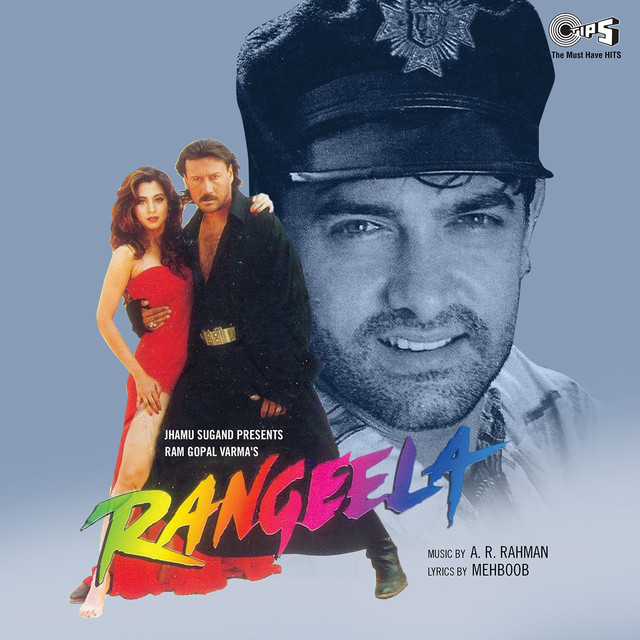
As the 1995 super hit film Rangeela gets ready for a re-release, the film’s director Ram Gopal Varma, now widely known as RGV, spoke to The Hindu‘s film critic Sangeetha Devi Dundoo. In the interview, published online on the paper’s website on 26th November, Varma rates Rangeela as one of his most satisfying films, along with Satya.
The interview is in the form of an article rather than as questions and answers. While this format offers readers a more coherent version of the interviewee’s views, a Q&A could’ve been instructive too, giving an insight into the questions put by the journalist.
Below are some snippets about what went into the making of the film:
The inspiration for some of the character traits of the protagonist, Varma tells Sangeetha, were drawn from a goonda named Ramesh who he knew during his college days.
“We saw Ramesh hesitating to confess his love for a girl. When she dated a rich guy, he said the girl might be better off with him. This quality of letting go, and wishing her well, came from Ramesh as well as the Countess of The Sound of Music.”
Sridevi, Rajinikanth and Nagarjuna were the first choices for the film, Varma says in the interview. But when he narrated the story lines of Rangeela and Govinda Govinda to Sridevi, she chose the latter. Later, while filming the thriller Gaayam, Varma was impressed by how Urmila, then a relative newcomer, choreographed and danced to a song when the choreographer could not make it to the shoot. “I decided to make Rangeela with Urmila,” he says.
How A.R. Rahman’s soundscape shaped the film
In the interview, A.R. Rahman comes across as the biggest factor shaping the film. “Rangeela’s backbone was its music. Varma was perplexed when Rahman pitched a rough track, without being accompanied by live musicians, as was the norm,” writes Sangeetha.
“The sound, orchestration, and how he processes the singers’ voices were all new to me. It was tough to decide if I wanted a tune, based on the rough track he hummed with a blank expression. When I first listened to the outline for ‘Hai Rama’, I thought Rahman sent me a Carnatic classical tune by mistake.”
“The reference I had given him for a sensuous, erotic song was ‘Kaate Nahi Kat Te’ from Mr India, and he gave me a classical tune. I thought it would put people to sleep.”
The tune grew on RGV like slow poison. When the orchestration was done, he was blown away.
The ‘Hai Rama’ song, RGV recalls, was not composed when he and Rahman travelled to Goa for this purpose.
“Each day he would come up with some excuse; finally he said ‘Ramu, next time don’t book me into a room that has television’. I was livid. […] Rahman’s method was new. If a director does not know what he wants, it can throw him off balance.”
Sangeetha writes that Varma often consulted Mani Ratnam, made him listen to Rahman’s rough tracks, and got his approval, given their novelty.
“Saroj Khan [the film’s choreographer] was startled when she first heard ‘Tanha tanha’… Later, when she could not give me the dates to choreograph the other songs, I asked her assistant, Ahmed Khan, to take over. He too was surprised by the music, disappeared for a few days, and when he demonstrated what he had in mind for ‘Rangeela re’, it was special.”
Newcomers’ hunger
The story recounts how the hunger of newcomers — Ahmed Khan and Manish Malhotra — along with Rahman’s music, helped Rangeela.
“The song ‘Kya karen’ came from the state of mind of Aamir’s character. The cinematography (WB Rao) was also not complicated. We would discuss the colours and compositions. In the ‘90s, we did not have concept artists for cinema. I just wanted all my characters to appear realistic.”
Test screenings were held to gauge the response, the director tells the journalist.
“One has to weigh feedback carefully since not everyone can point out what works or doesn’t for a film. A few didn’t care for the ‘Hai Rama’ song, but we went ahead.”