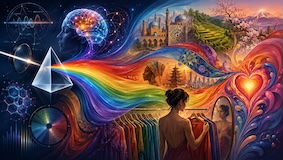
Colours can be compared to keys on a piano; one must know how to play them correctly.
Mukkamala Sriram
It is impossible to envision a world without colour. The sky cannot be blue nor the rose red, traffic lights cannot show what is acceptable to do and what is not, neither could we have all the vibrant schemes that we have come to accept as normal. It would be a world of bleakness and confusion; colours are not merely for visual attraction but are also used to deliver emotions, encourage specific behavior as well as be symbols of the cultures to which we are a part. These messages appear with us constantly yet we do not even perceive it.
The conversation of colours commences as we rise each morning. The sentiment of the present moment may differ from one minute to the next as we shift from the desolate grey heavens to the warm, bright sunshine beaming into our bedroom and as a result our feelings fluctuate between despair to delight. Colour psychology is not new, psychologists have studied it for many years.
Hues like yellow, red and orange all stimulate a feeling of being vibrant, passionate, energetic; contrasting colours such as green and blue generally make people feel relaxed and peaceful as well as encourage a feeling of safety and trust which explains the constant presence of blue and green in hospitals.
The capability of colour is not limited to conveying emotions; they can also influence decisions and behavior. Colour can also be utilized to influence how one reacts to purchasing a product; for example, fast-food chains are known for using brilliant shades of red and yellow because these colours encourage customers to feel more vibrant and energetic, whilst premium brands such as Louis Vuitton promote a sense of wealth and luxury through their gold, black and purple product casing. Usually, it is colour which draws our attention to a product before anything else is considered.
There are different meanings attributed to colours in societies around the world. White, in western cultures is associated with joy and welcomes new arrivals as well as suggests innocence and hope; in contrast, white in some cultures in the east, represent death and mourning. Unlike western cultures which associate red with love and desire, the east relates red with good fortune and joy. One should note that as a result of these interpretations people place upon colour that they have no single form but instead appear with variations in both dialects and languages depending on tradition, experience and history.
Animals’ colours also form a significant role. Many of colours that appear in animals may not appear to be related, yet, it serves to deliver signals to one another. Some warn of immediate danger (the bright colours will act as an alarm bell to all other predators not to consume), whilst some species of birds are highly adorned with such colourful patterns, such as male peacocks as an example, in order to appeal to and persuade females into mating with them. It could also be said that the shift in the colour of leaves with the changing seasons is reflecting the passage of time, and the inevitable process of aging and transformation. The colours associated with animals are constantly being modified into elaborate languages such as how a butterfly will evolve a specific iridescent colour, or how a ladybug has its specific spot patterns, as this contributes directly to survival and replication.
With the current age and our reliance upon digital mediums, we are attributing new values and significance to colour. It has infiltrated into the creation of websites, mobile applications and networks.
This can be clearly observed where blue is often used to create feelings of trust and security whilst green suggests notions of success, progress and an ecological disposition. Even the tiniest, almost insignificant icons, displaying notifications or the start of an action, are being employed to influence our opinions.
Colours may carry unique connotations for individual people, based on their past and also tradition, memories, hope and fear that might invoke strong reactions toward specific hues. Preferred colours can indeed become such an influential component to a person’s identity, they can almost become a part of themselves, enabling us to convey important personal stories and converting something seemingly ordinary like a passing day into an event that holds special significance.
Each specific role that colours are intended to carry out through their hue are not communicated by the colour itself; colours cannot convince, haggle or tell us explicitly how to feel, or behave, but is influenced by how we take in this colour, the sensitivity we associate with one colour compared to others and also its effect on our feelings and behavior. It is because of these factors that colours have their own inherent strength-the power they possess to convey certain feelings and emotions which words simply fail to efficiently represent.
As visual cues gain increasing relevance with each passing day, learning the language of colour will be indispensable. These symbols of colour represent something more than merely visible light; it shows our connection to the science that we have studied and our psychology, the place and cultures where we dwell and who we are as an individual and lastly, the external world and the emotions deeply rooted within our minds. The next time that you pause to consider the beautiful sky, select outfits for the day, or analyze images on your screen, take note of what colour is communicating to you because although they are silent, their influence is not.