Critic pans The Social Reckoning for tame politics of the director
The Social Reckoning, written and directed by Aaron Sorkin, released this week. Billed as a follow-up to the 2010 film, The Social Network, it dramatises the 2021 Facebook leak by the whistleblower Frances Haugen and Jeff Horwitz. Here’s the assessment of the movie by The Hindu‘s critic, Ayan Paul Chaudhuri, in his own words:
With The Social Reckoning, Sorkin is attempting to make sense of a world that has outgrown his understanding of it by returning to a scandal that broke five years ago, and while the Facebook Files remain a damning record of corporate negligence, it almost feels like he has only now discovered that the internet has gone to the dogs. This is nothing but sanctimony masquerading as political engagement, as though exposing Facebook’s crimes and performing the requisite outrage over them were sufficient enough to stave off the collapse of democracy as we know it.
Sorkin’s screenplay flattens Madison’s Haugen and Jeremy Allen White’s Horwitz into snarky, screenwriterly approximations of the two very real people whose painstaking investigation and considerable personal risks produced some of the most consequential investigative reporting of the century. Worse, the Sorkinisation of the espionage apparently required dressing Madison in a succession of flashy cocktail dresses so that hotel onlookers will mistake her clandestine meetings with Jeff for dates — an embarrassingly asinine creative liberty that just turns her professional risks as a whistleblower into an entirely avoidable excuse for some deeply juvenile titillation.
[The] film’s most damning failure is how utterly spineless Sorkin’s brand of social-justice filmmaking has become. […] The Social Reckoning makes a limp spectacle of his reluctance to name the political figures or institutions lurking behind its poorly sanitised allusions. His treatment of January 6 is even more revealing, with repeated recreations of the Capitol attack somehow making the whole affair feel nothing more than an extended exercise in police victimhood.
For a Hollywood-scaled exposé to ostensibly lay bare Meta’s role in the industrial-scale monetisation of public dysfunction and radicalisation, this is a spectacularly anaemic reckoning with the greed, negligence and political harm that Zuckerberg has perpetuated. Sorkin really, really wants to position himself alongside All the President’s Men and Spotlight, but all The Social Reckoning really accomplishes is exposing his lukewarm, neoliberal sensibilties, which is perhaps the worst possible combination when paired with his egregious limitations as a director.
Designers put up a fight at Paris fashion week

At Paris Fashion Week, which runs from 28 September to 6 October, the challenge is to make people spend on luxury goods they no longer aspire to. So how did the designers respond?
Some kept their clients fully front of mind, the way Daniel Roseberry put together a ready-to-wear show based on sexy deconstructions of the “Schiap jacket,” delighting his buyers.
Others have opted for shock factor. Matières Fécales, which shut down Place de la République, a square famous for public demonstrations, for its show titled “The 99 per cent”.
Featuring 99 non-Caucasian models of different ages and sizes, it was a personal and political rallying cry from co-founders Hannah Rose Dalton and Steven Raj Bhaskaran to those they feel are left behind by the system.
It generated an outpouring of solidarity on social media, along with scepticism as to how such fashion statements empower the masses if it’s only the 1 per cent who can afford to own the garments.
Pushing the boundaries of possibility comes in many forms. At Anrealage, Kunihiko Morinaga offered incredible colour-changing skirts and dresses via rippling 3D-printed scales, LED lights and E Ink paper scales, playfully stretching ideas of what clothes can or should be. (FT / 3rd Oct. 2026)
Queer theme wrapped in inventive film-making
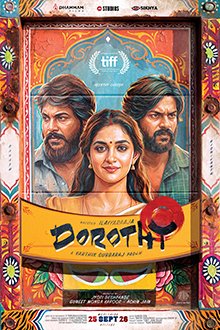
Tamil director Karthik Subbaraj’s new film ‘Dorothy‘ is apparently receiving some very passionate engagement on social media. It’s equally a rage among film critics. At least two of them are reading the film like a text rich in experience, meaning, and politics. Mint’s Uday Bhatia writes:
There are decisions taken that suggest that writer-director Karthik Subbaraj is spoiling for a fight, not just a debate. But it’s also a wild piece of filmmaking, richly allusive and kinetic, Bruce Lee rubbing shoulders with Bharathiraja, Coenesque black comedy with Madurai rowdyism. No scene is too small that Subbaraj won’t throw in some camera trickery or unexpected reference, a moment by moment return on audience’s investment.
Calling it the most important film of the year, The Hindu‘s critic Bhuvanesh Chandar writes that ‘Dorothy‘ is Karthik’s most cohesively written script, [and] his most progressive take on how caste, class and gender intersect. On its significance, Chandar writes:
‘Dorothy‘ might be the start of a queer revolution in mainstream Tamil cinema, and Karthik has shown real effort to understand some of what queer life in India means. The film allows you to understand the importance of pronouns, while a scene featuring a scorpion illustrates that even Nature is fluid. To speak in the language of hate that Dorothy seems to be attracting online, if this queerphobia and immorality are a zombie herd of ignorance and apathy, more mainstream representation of queer themes will be the flash flood of sense and scientific temper.
Both the critics specially mention the music of Ilayaraja, who is now 83 years old and the movie is his 1,151st. Chandar writes: “Fans of the composer have been eagerly waiting for the film ever since Karthik announced that he is using ‘Do Anything’ from the composer’s album How to Name It?, but nothing prepares you for the weight of the moment the track is used in.”
Nani-starrer ‘The Paradise’ was the big Telugu release this week, and his plaited hair brought it a lot of public attention. Critics though are calling the film, directed by Srikanth Odela of ‘Dasara‘ fame, a “misfire”. The Hindu‘s critic notes the effort that has gone into building a fictional world set in Secunderabad’s Paradise locality in the 1980s, its grunge-meets-dystopian visual aesthetic, and the cinematography by Ch. Sai. “What the film lacks, though, is the emotional heft to translate its ambitious ideas into an absorbing narrative,” she writes.
Something feels amiss. Is it the repetitive use of emotionally manipulative scenes in action dramas, or a failure of storytelling? The question lingered through the film. […] Several characters who might have seemed radical or interesting on paper, played by Kayadu Lohar, Sampoornesh Babu, Easwari Rao, Mohan Babu and Raghav Juyal, fail to make the desired impact.
‘Gondhal’ to be India’s official Oscar entry
Marathi film ‘Gondhal’ has been selected as India’s official entry to Oscars 2027. Written and directed by Santosh Davakhar, “Gondhal” is a cultural thriller rooted in Maharashtra’s traditional Gondhal ritual. The film features Kishor Kadam, Ishita Deshmukh, Yogesh Sohoni, Nishad Bhoir and Anuj Prabhu in key roles. Veteran composer Ilaiyaraaja scored the film, which was selected out of 33 submission, including four in Telugu (Sing Geetham, Peddi, Irumudi and Igwa.
Max names its artists

Max Fashion has put out the names of three artists whose art has been used in its latest Project New collections: Simon Raj, Pavithra and Manas. The three artists are part of Kairassi, a Chennai-based organisation working with differently-abled artists. Their original paintings have been taken “straight onto dresses, shirts, scarves and totes exactly as they were created,” the apparel company said. It also used an exclusive block print pattern, inspired by Japan’s sakura blossoms, by unnamed craftspeople from Sanganer in Rajasthan. Actress Kalki Koechlin, who is the brand ambassador for Max, personally shortlisted Kairassi and the three artists whose work anchors the collection. (Posted on 15 September)
(Not) Yet another Malayalam thriller
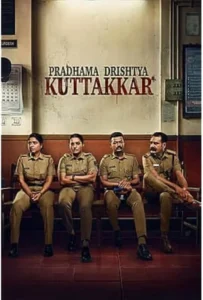
From the Malayalam film industry that churns out police procedurals by the dozen, a new thriller is winning praise for “injecting novelty into the genre”. The movie is ‘Pradhama Drishtiya Kuttakkar‘, which, the reviewer notes, has quite a few parallels with Jeethu Joseph’s Drishyam, but has very different concerns and approach to the crime.
Growing up, meeting someone
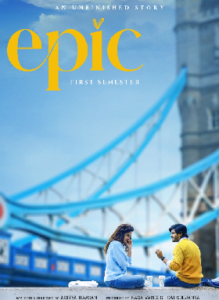
Remember the hit web-series ’90s: A Middle Class Biopic’, and the youngest child in that family, Aditya? Well, he has grown into his twenties, is now in the UK, meets a girl called Kadali, and the ‘Epic: First Semester‘ is his story. The central theme is apparently relationships and anxieties around commitment. Both the lead actors get praise for their portrayals, as does the music director for creating a supporting undercurrent. It’s the director who gets the critical appraisal. The reviewer says the director, also named Aditya, has taken a leap of faith, “holding back from pandering to familiar mainstream tropes”. She reads meaning into the film’s tagline, ‘an unfinished story’, and sees an intent to push the boundaries of the coming-of-age story in the words ‘point of view’ that follow the director’s credit.