Memories, dilemmas and lessons from three decades in Journalism
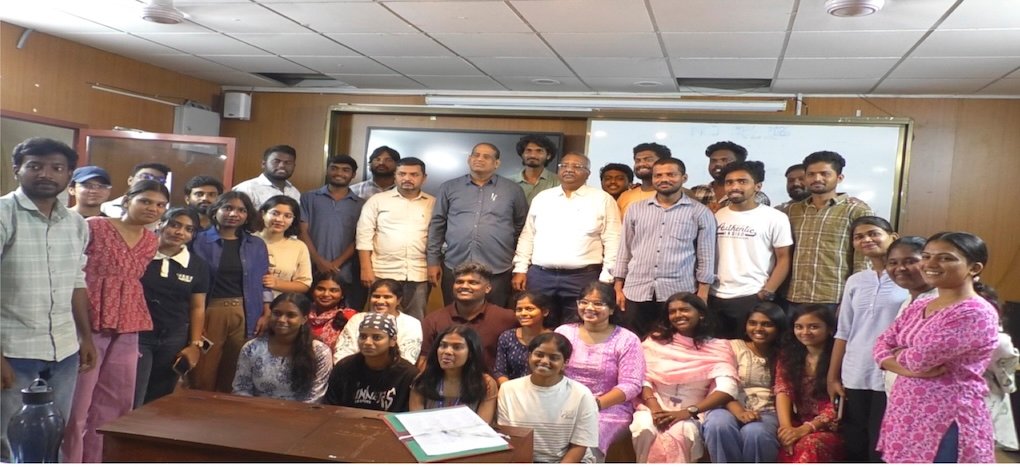
Fond memories from the classroom, gritty experiences from the districts, hard lessons in dealing with politicians, and radical shifts brought by technology — these were some of the themes laid out before a group of Journalism students by a former student and current resident editor of a prominent newspaper in a guest lecture recently.
Mr. Ravi Reddy, an alumnus of the Department of Journalism & Mass Communication from 1994-96 batch and currently heading The Hindu in Telangana, spoke about ‘Reporting in Transition: From Mofussil to Digital’, on 15th October.
A trip down the memory lane set the tone for the session. “These were the same desks… it was this same room… We used to be backbenchers, and three of my classmates are also my colleagues at The Hindu now,” he remarked about the Lecture Hall I.
Pondering upon the mechanics of news gathering, Mr. Reddy said, “There were no smart phones or Google maps to navigate through unfamiliar areas. My team and I used to travel for miles on a two wheeler to cover a story. It was not like today, when with the help of a smartphone any story in a remote area can be covered in a jiffy”.
Mr. Reddy narrated his experiences covering Naxals as The Hindu’s Nizamabad correspondent. He says it is very important for a reporter to maintain neutrality between the police and the Naxalites, and to have the necessary psychological composure. He also explained how a district correspondent has to cover a range of subjects from agriculture, sports, crime, politics, and Panchayat matters.
Political games
Drawing from his experience as a hardcore political reporter, Mr. Reddy shared his insights
about the challenges faced in political journalism. “Reporting on politics is a tricky challenge because politicians tend to offer misleading information, and that can drift you away from the actual event. Reporters must proceed with caution and cross-verify every information from the primary source to maintain accuracy, fairness and objectivity,” he said.
Mr. Reddy also highlighted the recent changes in covering the Assembly sessions,
juxtaposing the traditional and digital method of reporting. “At present, the proceedings are
being livestreamed and reporters follow the telecast to file their reports. Earlier, reporters would sit through the entire session and would take turns every two to three hours to note down everything meticulously. Back then, when the Speaker expunged any remarks made by MLAs from the Assembly’s record, it would not be reported. But now everything said by the Members is in the public domain,” he explained.
Transition to digital
Mr. Reddy reflected further on the dazzling changes brought by digital technologies and A.I. Reporting was built on source networks, credibility, interpersonal communication and compatibility. Journalists relied on press releases, one-one interaction with the grassroot level officers to gather the information, he said.
The transition into the digital era has maximised speed and reach, he said. Access to information has become seamless through websites, social media and government portals. Now verification poses a challenge. In the rush to publish the story, speed has acquired primacy over accuracy weakening the core strength of journalism.
He highlighted the importance of one-on-one interaction with the sources for cross-verifcation rather than going with the flow because reputation is built on accuracy. Rather than relying on Google searches and ChatGPT, he urged the future journalists to step into the field, do the legwork and gather the information.
The speaker stressed on the importance of fact-checking. “A situation will arise when the source will try to provide conflicting or false information, It is crucial to always back it up with relevant data and cross-check it with the primary source,” he added.
In his concluding remarks, Mr. Reddy reaffirmed that even though the technology has evolved, the core foundational values of journalism remain unchanged. He encouraged
the future torch bearers to resist the temptation to depend on A.I. and rely on questioning and scrutinising evidence.