‘For voters, cash and gifts are the instant gratification’
By Madiha Nahid
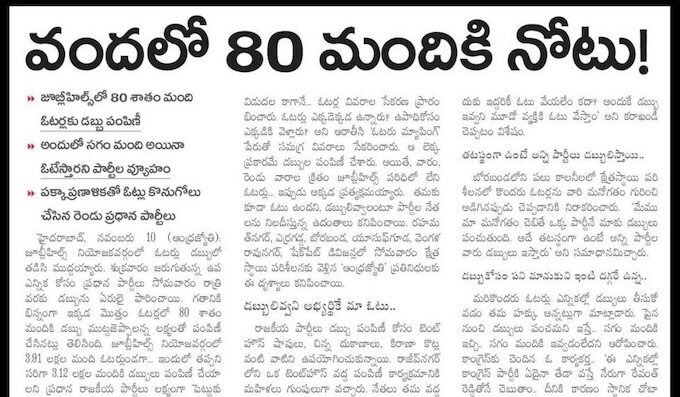
In the by-elections to Jubilee Hills and a few other constituencies in 2025, the role of money was very much in focus. Reports highlighted how commonplace it has become for political parties to distribute cash and for voters to expect money or gifts in return for their vote.
To understand the psychological aspects of this phenomenon, JMC>forum spoke to Dr. A. Anupama, Chairperson (Board of Studies), Department of Psychology, Osmania University.
Dr. Anupama notes that human behaviour often responds positively to incentives and that money has become one of the most effective incentives to influence voter behaviour.
“When people receive immediate rewards, they are more likely to respond favourably. This idea is rooted in behavioural psychology, where money acts as a reinforcement for positive behaviour,” she said.
Money is linked to the perceived ability and seriousness of the candidate.
In the context of elections, politicians use this technique to persuade voters. “Though political parties make promises in their election manifestoes, people are often not fully satisfied with future assurances. The key is ‘instant gratification through cash distribution’,” she explained.
From the voters’ perspective, money is linked to the perceived ability and seriousness of the candidate. Dr. Anupama refers to an Oxford study on political psychology, which suggested that wealthy individuals are often perceived as powerful during elections, which attracts voters.
In addition, the voter is with the idea that ‘I am being offered money because I matter,’ she explained. “Voters always feel a sense of power when they are offered money and people enjoy being powerful”, Dr. Anupama says.
Even though voters are aware that accepting money is unethical, many still do so because this practice has become normalised.
Dr. Anupama highlights the impact of this practice on democracy. She states that the growing monetisation of elections poses a serious threat to democracy. “When money becomes the most significant indicator of power and growth, democratic values weaken”, she says.
Accepting money and voting for a candidate based on perceived money power reduces citizens’ moral authority to question or hold leaders accountable after elections.