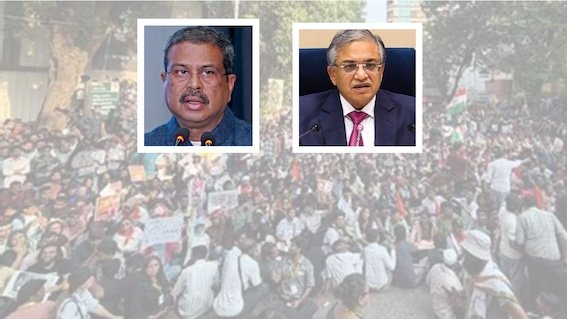
Demand for resignation: What explains the different outcomes?
The Indian Express expose on 23rd September disclosing differences within the three-member Election Commission in recent months has consolidated the widespread but diffuse sense of unfairness and powerlessness around Special Intensive Revision (SIR) into a clear demand for the resignation of the CEC Gyanesh Kumar.
Until then, reports on SIR-related issues were regular but disparate. No amount of conscientious appeals by the opposition could sublimate the concerns into a clear demand. By exposing weaknesses inside the core of the election body, the Indian Express story had the effect of identifying the one flaw that needed to be remedied.
The way youth protests at Jantar Mantar recently forced the resignation of Dharmendra Pradhan as Education Minister is still fresh in public memory. But contrary to expectation, even after the demand for CEC’s resignation became the main slogan, it did not seem to have had much effect. What explains this?
Process is different for ECs
— Jerusha Shailu
The disparity between the resignation of Dharmendra Pradhan ( Union Education Minister) and Gyanesh Kumar ( Chief Election Commissioner) mainly arises from their Constitutional standing, accountability and removal protocol.
A cabinet member can be dismissed or removed by the head of the Government or by voluntary resignation. Due to the intense protests over the NEET paper leak, Mr. Pradhan was asked to step down from his position.
On the contrary, the Election Commissioner holds an autonomous and independent Constitutional body. As per Article 324(5) 2023, a sitting CEC cannot be dismissed by the government. It can only be done through a formal parliamentary impeachment process. Hence the different outcomes of resignation.
EC has a different status and procedure
— Madiha Nahid
Dharmendra Pradhan, the Minister of Education, resigned amid continuous protests by the Cockroach Janata Party (CJP) over the NEET examination paper-leak controversy. The NEET examination paper leak was a major concern because it affected the future of millions of students. As the Education Minister, Dharmendra Pradhan was directly accountable to Parliament and the public. The youth-led protests and widespread public unrest created political pressure on the minister to resign.
Chief Election Commissioner Gyanesh Kumar, however, remains in office despite mounting pressure and nationwide protests following allegations of voter-roll manipulation.
Under Article 75 of the Indian Constitution, Union ministers hold office during the pleasure of the President. In practice, the Prime Minister can advise the President to remove a minister from office. A minister therefore does not have the same constitutional protection from removal as the Chief Election Commissioner.
The position of the Chief Election Commissioner is different. The Prime Minister cannot simply remove the Chief Election Commissioner in response to public protests or political pressure. Under the Constitution, the Chief Election Commissioner can be removed from office only through a process involving Parliament, on grounds and through procedures similar to those applicable to the removal of a Supreme Court judge.
Therefore, although both cases involved public protests and demands for resignation, the constitutional positions, accountability mechanisms, and removal processes are fundamentally different.
Same demand, different intensity
— S. Keerthana
The contrasting outcomes of these similar demands can be attributed to differences in the way the protests unfolded and their intensity. The resignation processes for the two positions are also different, and so are the ways in which the respective offices operate.
While the public protests and demands may appear similar, the contexts in which they occurred are different. The student protests led by the Cockroach Janta Party caused public distress and put political pressure on Dharmendra Pradhan to resign.
Accountability for EC is not the same as that for an elected representative
— G. Srikanth
There are significant differences in how accountability is understood in the cases of the Education Minister and the Chief Election Commissioner.
The protests that erupted over the NEET paper-leak controversy led to demands for the resignation of the Education Minister. Such a resignation can be viewed as a form of political accountability, particularly when a minister is responsible for a ministry whose decisions directly affect the public. As a political representative, a minister is ultimately accountable to Parliament and, indirectly, to the people.
The resignation of the Chief Election Commissioner, however, does not work in the same way as the resignation of a minister. The constitutional and administrative structures governing these two positions are different. The Election Commission is an independent constitutional authority, and the Chief Election Commissioner has specific constitutional protections regarding removal from office. The Commission is responsible for implementing and administering the electoral framework established by the Constitution and laws enacted by Parliament; it is not a superior authority to the government or Parliament.
At the same time, allegations of electoral irregularities, including voter-roll manipulation and other concerns about the electoral process, have led to demands for reforms. Measures such as the Special Intensive Revision (SIR) are presented as efforts to update and strengthen electoral rolls. However, such measures can also generate controversy when questions arise about their implementation and their potential effects on voters.
Ultimately, the public may perceive political leaders as more directly accountable because elected representatives derive their authority from the people through elections. The Chief Election Commissioner, by contrast, is appointed through a constitutional process rather than directly elected by the public. This difference does not mean that the Election Commission is free from accountability; rather, its accountability operates through different constitutional and institutional mechanisms.
Evidence matters, not just demand
— B. Kranthi
The key issue isn’t simply whether Gyanesh Kumar should resign; it’s whether the SIR process is being implemented transparently, consistently, and with adequate safeguards so that eligible voters aren’t wrongly excluded. If credible evidence establishes serious procedural failures, accountability including institutional or legal action becomes important. If the allegations aren’t substantiated, a resignation demand by itself isn’t enough.