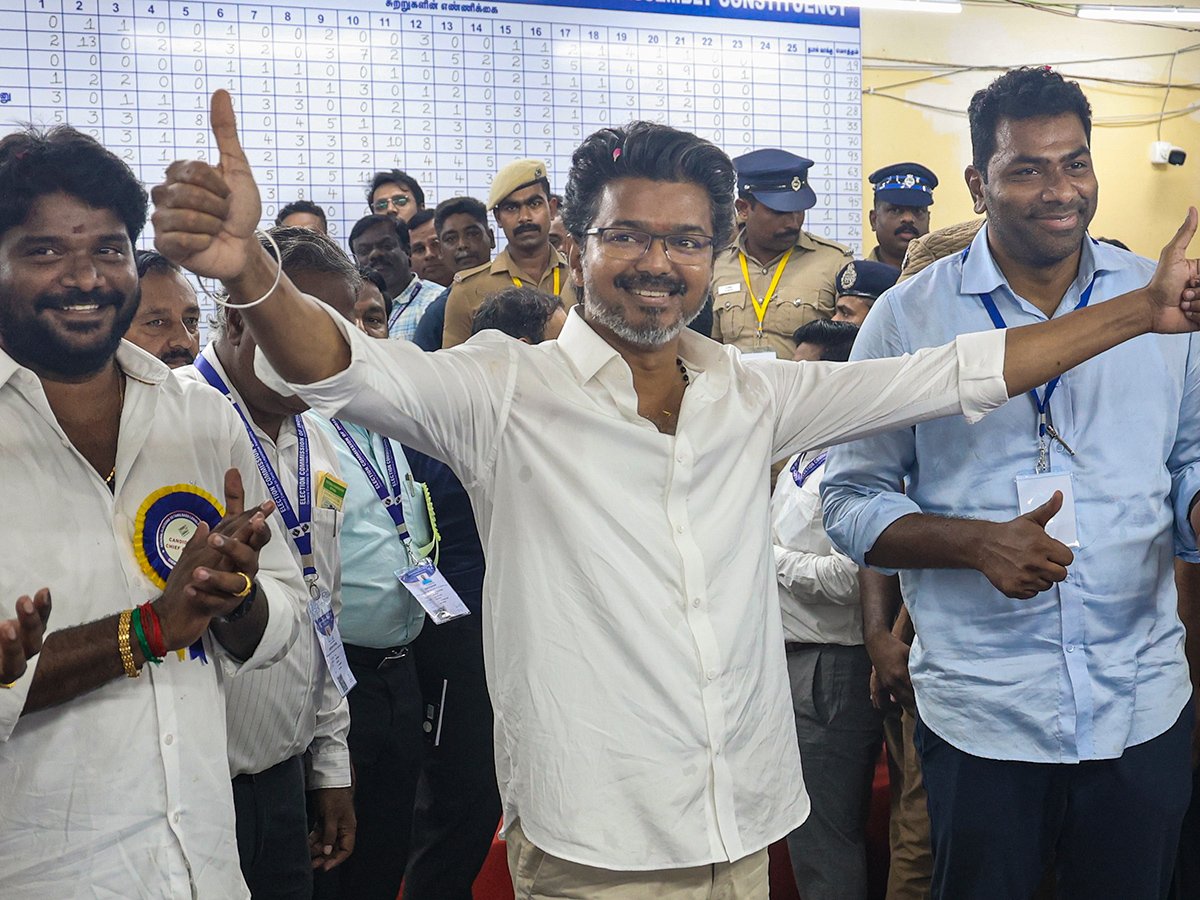
Six factors that shaped Vijay’s surprise victory
Actor Vijay’s victory in the Tamil Nadu Assembly election could be termed a surprise, an upset and a puzzle, all at once. Here’s a thorough review and explanation that it needs.
When actor Vijay entered electoral politics with the launch of Tamilaga Vettri Kazhagam (TVK), he already had an advantage most new political leaders do not have: a huge fan base and an established presence across and outside Tamil Nadu. His fan clubs had also been involved in welfare activities before TVK was formed. According to the Economic Times, members of Vijay’s fan associations contested local body elections as independents in 2021, with 115 of 169 candidates winning. This showed that his fan network could be turned into an electoral network.
1. Social media was the campaign platform
Vijay’s strongest advantage was his ability to communicate directly with a large digital audience. According to NDTV, Vijay had around 17 million Instagram followers by the time of the 2026 Assembly election. His audience was also highly engaged. His Reels averaged around 31.3 million views, 3.4 million likes and 1.36 lakh comments. More than 71 per cent of his Instagram audience was between 25 and 34 years old. It was also an audience that was willing to interact with and share his content. NDTV reported that one of his political videos received around 19.5 million likes and 3.67 lakh comments. This allowed Vijay to gradually turn an audience that had followed him as an actor into an audience for his political communication.
TVK also used Instagram, YouTube, X and WhatsApp extensively. The Economic Times reported that its IT wing produced Reels, short videos and graphics, while a team called “Voice of Commons” created content aimed particularly at younger voters. The content focused on social justice, equality, welfare and clean governance. The party also benefited from supporters who circulated its content through their own social networks. This meant TVK’s communication could travel beyond its official accounts and reach people through friends, relatives and other supporters.
2. Social media was supported by a ground network
Vijay did not depend on social media alone. TVK tried to convert his existing fan clubs into a political organisation. The Economic Times reported that the party planned to appoint more than 70,000 booth level agents. This was important because online popularity does not automatically translate into votes. The party needed people working at the local level to mobilise voters.
There was also a professional political strategy behind the campaign. According to a report by Deccan Chronicle, Kapil Sahu, a former I PAC strategist, played an important role in TVK’s campaign. His experience included election strategy, campaign planning, data analysis and political messaging. The combination of Vijay’s celebrity appeal, social media reach, fan networks and professional campaign strategy gave TVK a campaign structure that a new political party normally takes years to build.
3. Young voters were key
The digital campaign also helped Vijay connect strongly with young voters. The Economic Times reported strong interest in TVK among first time voters and those in the 20 to 29 age group. Vijay’s existing popularity among young people from his film career gave the party an additional advantage.
NDTV also reported instances of young Vijay fans influencing their parents’ voting choices. One parent told the publication that she had previously voted for DMK and AIADMK but would vote for TVK because her son wanted her to. This does not mean that young voters generally decided their parents’ votes. But it shows how Vijay’s popularity among young people could influence political conversations within families.
4. A controlled political image
The Economic Times reported that Vijay largely avoided frequent press conferences and unscripted interviews during the campaign. This allowed TVK to control his public communication more carefully.
Social media therefore became particularly useful. Vijay could decide what message to release and communicate it directly to his followers rather than depending entirely on traditional media. This helped him maintain an image of a new political leader who was different from the established political class.
5. The politics behind the campaign
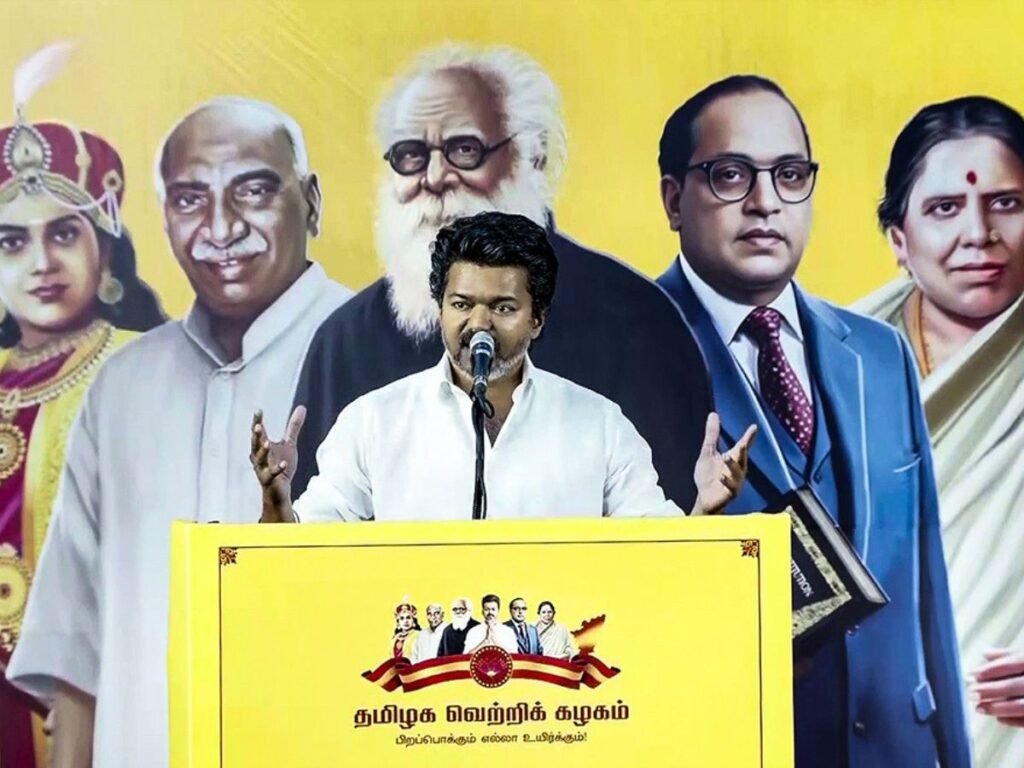
Tamil Nadu politics has traditionally been dominated by the DMK and AIADMK, both of which are rooted in the broader Dravidian political tradition. Vijay entered this political space with TVK as a new alternative. The party focused heavily on corruption, clean governance and political change.
However, Vijay did not completely reject the Dravidian political framework. TVK itself speaks about social justice, welfare, secularism and Tamil identity. Therefore, Vijay’s disruption is better understood as a challenge to the DMK-AIADMK political duopoly, rather than a rejection of Dravidian ideology itself.
The Hindu described TVK as disrupting Tamil Nadu’s long standing “Dravidian bipolar” political structure. According to the Election Commission of India, TVK won 108 of the 234 Assembly seats, becoming the single largest party in its first Assembly election.
6. Played victim after Karur stampede
The campaign also faced a major crisis after the Karur stampede in September 2025, in which 41 people died at a TVK rally. The police account raised questions about crowd management and the organisation of the rally. Vijay rejected responsibility and blamed the administration. Deccan Herald reported that Vijay said he and his party had done nothing wrong and questioned the government’s role in the incident.
From a public relations perspective, Vijay attempted to shift the focus from questions about TVK’s responsibility towards the role of the administration. However, it would be inaccurate to say simply that the DMK stopped Vijay from campaigning in Karur. There were disputes over venues and arrangements, but permission was eventually given for the rally site.
Implications
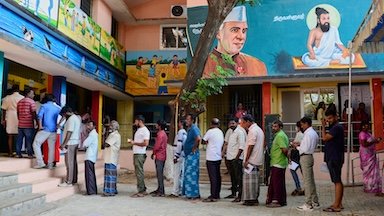
The DMK AIADMK political space is no longer closed
For decades, Tamil Nadu’s main electoral competition has been between DMK and AIADMK. TVK’s performance shows that voters are willing to consider a new political force. This does not mean Dravidian politics has disappeared. Instead, the DMK AIADMK duopoly has been challenged. The established parties may now have to work harder to connect with younger voters and people who are less attached to the traditional political camps.
It could open space for other political forces
Vijay’s success also shows that the established political structure can be challenged. This could create opportunities for other political forces, including the BJP. The BJP has historically struggled to become a dominant standalone force in Tamil Nadu because of the strength of Dravidian politics and Tamil regional identity. However, TVK has positioned the BJP as an ideological opponent. So Vijay’s success does not automatically mean the BJP will benefit. The larger implication is that the political space has become more open to new forces.
Annamalai could be another challenger
Former BJP leader and IPS officer K. Annamalai has also launched a new political movement, We The Leaders, after leaving the BJP. The Indian Express reported that the movement is being built with a possible political party and the 2031 Assembly election in mind. Annamalai could potentially compete with Vijay for some young, first time and anti establishment voters. However, their political positions are different, and it is too early to know how this competition will develop.
TVK’s biggest challenge is now itself
Vijay’s biggest strength is also TVK’s biggest weakness as the party is strongly identified with him. The next challenge is to build an organisation that is larger than Vijay’s celebrity image. TVK will need experienced leaders, strong local structures, administrative ability and institutional strength.
The larger question is therefore not whether Vijay can attract voters. He has already shown that he can. The question is whether he can turn his personal popularity and social media driven campaign into a durable political institution.
Vijay’s campaign has therefore shown how celebrity popularity, social media, fan networks, professional political strategy and anti establishment politics can come together to challenge an established political order in Tamil Nadu.